
Last updated on August 2, 2025 by Shannon
The faint lilt of a bagpipe rode the gentle breeze as I wandered to the main street of Fort Augustus. The town is small—tiny actually—and most of the action takes place along the Caledonian Canal, which feeds into Loch Ness.
This is a busy passageway through the area since the canal connects several of the main Lochs (lakes), and uses an intricate locks system to safely move boat from into the calm waters of Loch Ness.

Although the legend and myth of Nessie is one key reason people visit this area, it’s also to see the locks and take in the sights and things to in Fort Augustus. Foot bridges span over the canal’s locks and tourists jostle for spots, especially when a boat moves through!
Tilt the camera just right and aim for an arty shot.
Fail. I have yet to discover a way to make the locks actually look interesting—I encountered this in Panama’s Canal Zone as well—but they are undeniably as popular as Loch Ness itself here in Fort Augustus.
Meeting Spud, Fort Augustus’ Bagpiper
The bagpipes grew louder the nearer I made it to the central tourist area until I rounded a corner. There before me was a piper in full Scottish regalia piping out his heart to the small crowd of tourists.
And while the intellectual part of me understands that the piper was piping specifically because of the tourists—because what normal person would wake up thinking, “Gee, perhaps I’ll put on this outfit and jam by the single most touristy spot in town”—it didn’t detract from the cool factor.
Bagpipes are one of those instruments that most people (outside of Scotland for sure) rarely hear live. And that’s a shame because it’s beautiful.
I settled into a cozy spot on the grass near the bagpiper, content to much on an apple and listen to him play. Tourists ebbed and flowed past the piper, many snapping photos and tossing him a few coins before heading to the locks and shops and pubs lining the canal.
History of Bagpiping in Scotland

The haunting melody of the bagpipes has echoed across Scotland’s rugged landscapes for centuries, providing a musical soundtrack to the nation’s history, struggles, and celebrations.
Bagpiping in Scotland traces its roots back to ancient times, but it’s generally accepted that the instrument was brought to Scotland by the Romans or the Normans. Over the centuries, it evolved into the Great Highland Bagpipe, distinct in its fuller tone and range compared to other European bagpipes.
The significance of the bagpipe in Scotland cannot be overstated. In the early days, it was a shepherd’s instrument, used to entertain and, perhaps, scare off predators. It wasn’t long before the bagpipe found its place on the battlefield, serving as an instrument of war. Its mournful, resonant notes could be heard over the clash of swords and screams of battle, both guiding troops and demoralizing enemies.
After the Battle of Culloden in 1746, where the Jacobites were defeated by British forces, bagpipes were considered “weapons of war” by the British government, and playing them was outlawed for several years.
In modern times, the bagpipe is a symbol of Scottish culture and identity. It has transcended its military role and is now a staple at celebrations, ceremonies, and public events. It’s played to ring in the New Year, at weddings, and even at funerals as a way to honor and remember the departed.
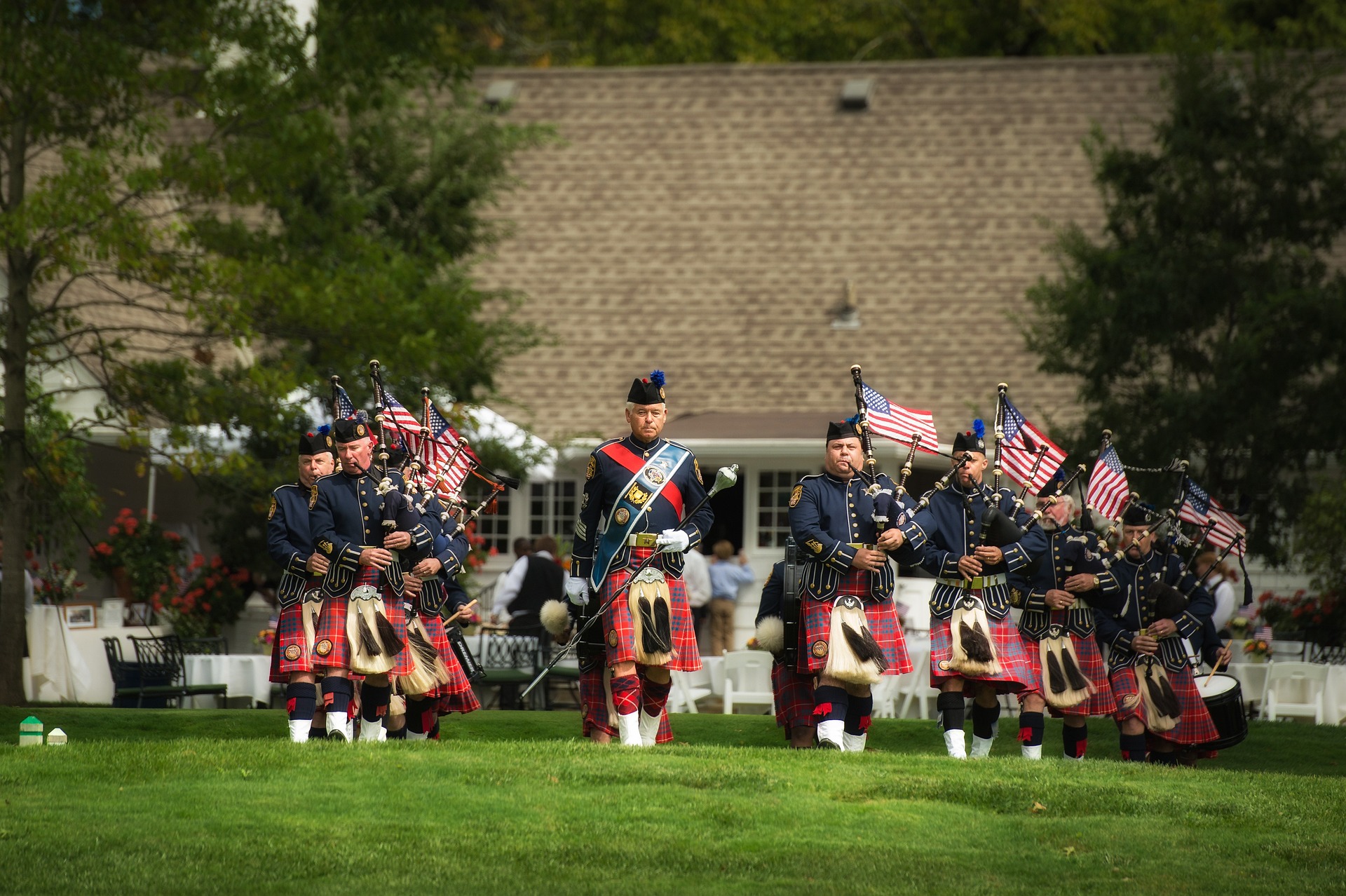
Various regional styles and tunes (known as piobaireachd) have been developed, each with its own set of intricate fingerwork and grace notes, making it both a complex and rewarding instrument to master.
Today, international competitions and gatherings such as the World Pipe Band Championships draw pipers from around the world, underlining the bagpipe’s enduring appeal and its integral role in Scotland’s cultural tapestry.
How I Ended Up Hanging Out with a Scottish Bagpiper

During one of his breaks, the bagpiper introduced himself to me as Spud—I would come to learn that he is a well-known bagpiper! We got to chatting and Spud felt the way many feel upon learning I am a born and raised Floridian: bewildered that I lived in such densely layered heat and humidity.
I continued listening and relaxing—at least until Spud slipped in a couple of American nursery songs into his next set! That had my head whipping up, laughter bubbling out. Hearing “Skip to my Lou,” “Clementine,” and other such songs from his bagpipes seemed both anachronistic and highly amusing!
Spud plays bagpipes regularly in Fort Augustus, most every day during the high season, so throughout the week I often aimed a friendly wave in his direction as I made my way to the tiny multi-purpose grocery store/café/ restaurant to pick up dinner fixings.
And on my last day, I spent several hours listening and relaxing while waiting for my bus out of town, which is how I ended up in the hitchhiking debacle!
Debacle aside, the interactions with Spud, the grocery store owner, and others is an aspect I simply love about small towns all over the world. Fort Augustus is one; I loved Český Krumlov most recently, and long before that I stayed an extra week in Luang Prabang just to soak in the good vibes.
Staying a bit longer than the “must-see” things require lends new dimensions to what can seem touristy and one-dimensional.