
Last updated on October 13, 2026 by Shannon
What round-the-world trip is complete without a classically cheesy photo holding up the Leaning Tower of Pisa. Although I usually record the iconic places I’ve visited with jumping shots, there’s only one pose that’s appropriate for the Leaning Tower of Pisa—and let’s be frank, I also wanted to see whether it really looked that strange in person.

My bestie Jenn and I had both never seen the tower, and since we’d just hiked Cinque Terre and were taking the train to Florence, it made sense to pop into Pisa along the way. The train line runs straight through town, so it’s an easy excuse to stop for a few hours en route. Here’s what you need to know about spending a day—or just a few hours—in Pisa.
Why Does the Leaning Tower of Pisa Lean?

OK, I know what you’re thinking: why does it lean? It comes down to bad luck and soft ground, not an earthquake or shifting earth, despite what you might have heard.
Construction began in 1173 and continued for just shy of 200 years before it was completed in 1372. The tower began to tilt during construction because the soft ground on one side of the site couldn’t support the weight of the foundation—as soon as builders started on the second story, it began to sink and tilt.
Builders tried correcting the lean almost immediately, adjusting column heights and reinforcing sections over the centuries, but the tower kept tilting anyway. Engineers finally stabilized it in the early 2000s by removing soil from beneath the higher side of the foundation.
Getting to the Leaning Tower

For some reason, I expected the tower to be visible the moment we stepped off the train. It’s not—the Leaning Tower sits in the Square of Miracles, a 20–25 minute walk from Pisa Centrale station, and back on my first visit (pre-smartphone days), we had neither a map nor directions for how to get there.

With few other tourists near the station to copy, and our backpacks on since we planned to continue to Florence after lunch, it took some figuring out. My cousin and I have a bit of Italian between us, and Jenn speaks Spanish, so we split up to question strangers on how to get to the tower.
Eventually, a really nice Italian guy took pity on me. We were having trouble communicating in our mangled Italian-English, so he grabbed my hand, walked me about 500 feet around a corner, and deposited me at a bus stop with firm instructions on which bus to take. I thanked him with a mille grazie and hollered for Jenn and Helen to join me. Two minutes later we boarded Bus 4, and it dropped us right on the doorstep of the Square of Miracles.
These days you don’t need the luck of a kind stranger: it’s a cinch to activate an eSIM or grab a local SIM when you land in Italy and let Google Maps point you to the fastest bus. And if you’re coming from Florence specifically, look for trains stopping at Pisa San Rossore instead of Pisa Centrale—it’s a tiny station just five to seven minutes’ walk from the Square of Miracles, and dramatically calmer than arriving at Centrale. There’s also a self-service luggage storage option at Pisa Centrale now, which didn’t exist on my first visit and makes the few-hours-in-Pisa plan easier if you’d rather not lug a backpack around the square.

My cousin Helen had already visited the Tower, so she planned to spend the afternoon in a coffee shop catching up on work (like me, she works online). Jenn and I dropped our backpacks behind Helen’s chair and headed into the Square of Miracles to explore and take photos on our own. The site isn’t huge, so it’s easy to see in an hour or two.
Self-Guided Tour of the Square of Miracles

The Square of Miracles holds the three main sites—the Baptistery, the Cathedral of Santa Maria Assunta (which includes the tower), and the Camposanto—and you can see all of them in about two hours if you’re just passing through. Start early: aim to arrive by 9 a.m., since tour buses and crowds descend fast after 10.
The white marble is blinding in strong summer sun, and the whole area gets brutally reflective by midday—the marble plus open lawn can feel hotter than Florence itself. But it’s worth it. The church, the bell tower, the whole complex glows white in the sun, and the tower itself juts at such a precarious angle against the straight lines around it that it looks better suited to a Ripley’s Believe It or Not exhibit than an actual, still-standing monument.
Get Your Cheesy Photo


If you have your heart set on a cheesy photo holding up (or knocking down) the tower, do it the moment you arrive—morning light is noticeably better, and by afternoon the square heaves with crowds and the tower side facing the lawn gets harsh shadows.
As I am sure everyone has experienced, some people just don’t understand that when you ask for a photo of you in front of a major monument, you kind of want the monument in it, too. We scoped the area until we spotted two women in their late twenties jabbering in English—perfect. The one taking our picture was so committed to getting the shot right that she kneeled on the ground even though she was wearing pristine white pants. Now that’s commitment I can respect. The shot looked great, and we reciprocated with a good one of the two of them before heading off toward the bus stop. Staff do keep an eye on the lawn during peak hours, so don’t expect unlimited time for elaborate photo staging.
Should You Climb the Tower?

Jenn and I didn’t pay to go up, but if you’ve got a full day in Pisa rather than just a few hours, book a timed-entry ticket ahead, especially for the early morning slots in summer when the light and crowds are both better. The tower opens at 9 a.m., and it’s a steep climb up roughly 294 spiral steps—tiring, but the views from the top are worth it. You can’t bring bags up, but there’s a free bag check included with your ticket near the entrance.
Ticket prices and combination packages (tower plus Cathedral, Baptistery, and Camposanto) change fairly often, so check the official pricing page linked above rather than trust a number I quote here—but budget more if you want the full combination over just the tower and Cathedral.
Cathedral, Baptistery & Camposanto
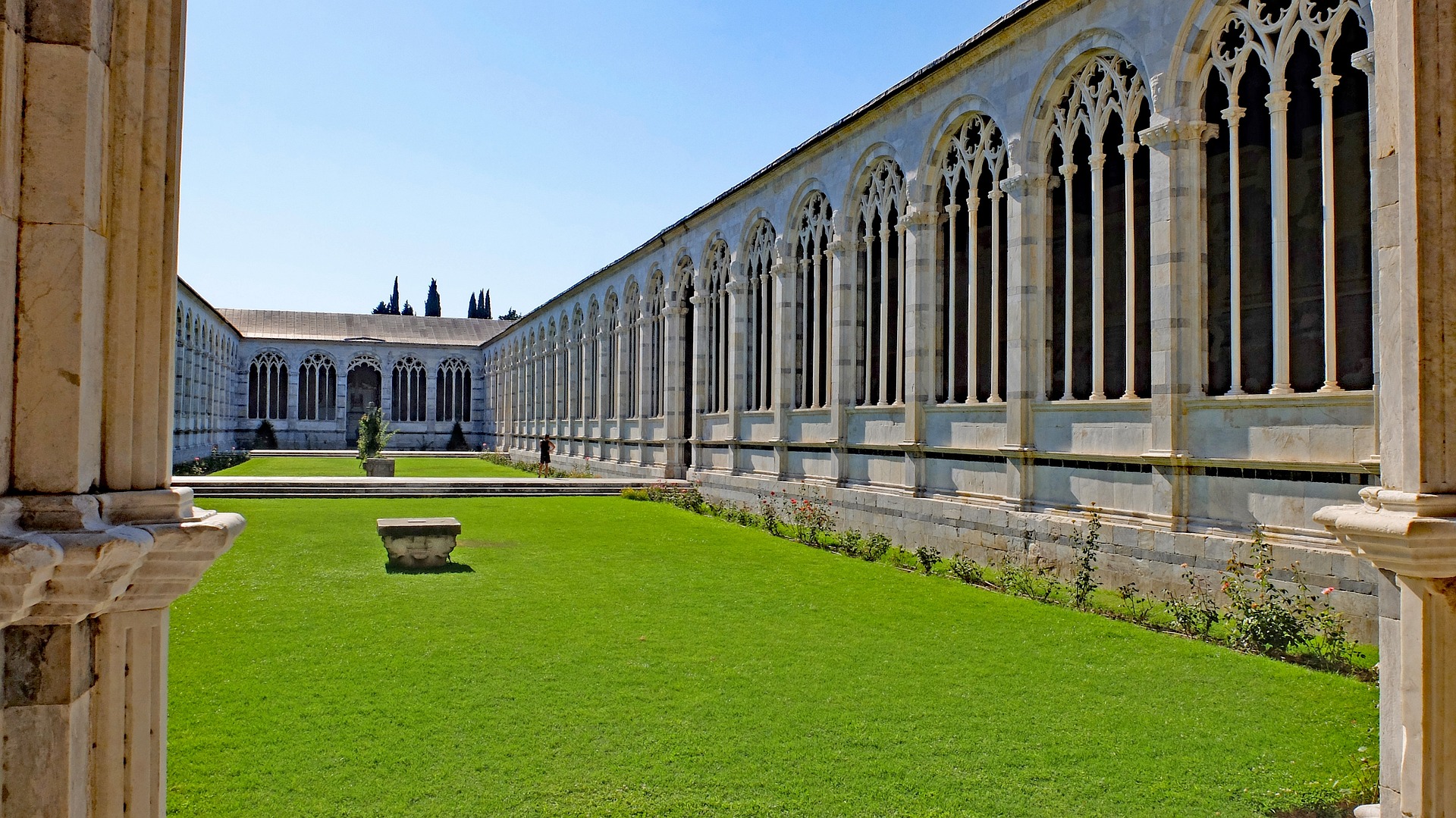
It’s easy to let the tower eat your whole visit, but the other three sites are worth the extra twenty minutes each. The Cathedral of Santa Maria Assunta has striped marble, an enormous nave, and an intricate pulpit by Giovanni Pisano. The Baptistery is famous for its acoustics—staff occasionally demonstrate the echo effect inside, and it’s genuinely mesmerizing. And the Campo Santo Monumentale, a 13th-century cemetery with Gothic cloisters and weathered frescoes, is quieter than the rest of the square and a nice last stop once the tower crowds get to you. According to tradition, the soil here was brought back from the Holy Land during the Crusades, which is where the cemetery gets its name—”holy field.”
If you have a few extra minutes and walked from Pisa Centrale, swing by Keith Haring’s Tuttomondo mural near the station—one of his last public works before he died, painted directly onto the wall of the Church of Sant’Antonio in 1989. It feels wildly different from the medieval atmosphere around the tower, and it’s a nice contrast if you’re walking that direction anyway.
Grab a Meal and a Gelato

No matter how long you’re spending in Pisa, you have time for gelato. We grabbed lunch and a cone after our time at the tower, then wandered a bit along the River Arno before heading back to the station—it’s calmer there, less tour-group energy, more everyday Italy. Honestly, Pisa is one of those places where you should just stop when a gelato case catches your eye. We did, and it worked out perfectly.
Planning Your Visit to Pisa

Pisa gets slammed by tour groups between roughly 10:30 a.m. and 2 p.m.—the difference between arriving at 9 and arriving at noon is enormous, and the square calms down again after about 4 p.m. If you only care about the tower, photos, and wandering the square, two to three hours is genuinely enough.
Pisa sits right on the main line between Cinque Terre and Florence, which is what makes it such an easy stopover. From Florence, trains take about an hour and run frequently; from La Spezia (the usual hub for Cinque Terre), they run roughly every thirty minutes. Check timetables at Trenitalia or Omio. One thing I’d do again: book onward tickets at least a day ahead if you’re traveling in August—when we came through, the evening trains into Florence were nearly sold out.
From Bologna, expect roughly two hours with a change in Florence.
Is a Day Trip to Pisa Worth It From Further Away?
Do the math before you commit, because it changes depending on where you’re starting.
From Rome: this one actually works. There are direct trains—no change in Florence needed—and the fastest take just over two hours each way, with around a dozen direct departures a day. That’s four to five hours of travel for a half-day in Pisa, which is a long day but a genuinely doable one if you start early.
From Milan or Venice: this is a tougher sell. Both routes usually require a change in Florence, and you’re looking at three and a half to four hours each way—six to eight hours of travel for maybe three or four hours on the ground in Pisa. I wouldn’t do this one as a there-and-back day trip. If Pisa is genuinely on your list, treat it as a stopover on the way to or from Florence instead, the same way I’ve always used it between Cinque Terre and Florence, rather than a round-trip from Milan or Venice itself.
Whichever direction you’re coming from, book your tower climb ticket online before travel day, not when you arrive—slots are timed and limited, and a day-tripper with a tight window can’t afford to be shut out. And check your return train time before you lock in a climb slot; if you’re cutting it close, skip the climb and keep the photos and the square instead.
We stopped between Cinque Terre and Florence: dropped our bags, explored the square, got our cheesy photo, had lunch and gelato, then caught an evening train onward. It never needed to be more complicated than that, and honestly, that’s why people keep stopping here even knowing exactly how touristy it is.
Onward travel
Having explored large swaths of Italy across many trips, here are some guides and information about the other things to do in the region.
Across Italy » Cinque Terre | Assisi | Pisa | Ostia Antica | Rome
Florence » The David Statue | Wine Tour by Bike | Boboli Gardens |
Other» Solo Female Travel Safety | Best Gelato Flavors | Italian Culture
Such a great post! Pisa has always been on my bucket list, and your tips make it even more tempting. Time to book my Italy visa appointment and finally see the Leaning Tower in person!
When we visited the leaning tower of Pisa we scheduled CLIMBING the tower with the tour we were on with the cruise line. Those BIG bells are still up there at the top.
P. S. The leaning has now been stabilized for supposedly for the next 200 years.
“some people just don’t seem to understand that when you ask for a shot of you in front of a major monument…you kind of want the monument!” – So damn true!
You are so lucky! What amazing pictures.
I am going to Pisa for a week’s holiday in August and stumbled across your site here and it made me laugh so much. I now can’t wait to go and hopefully I’ll be doing the same cheesy pictures that you have done here.
Thank you!
Thanks for stopping in – enjoy your own trip in August and definitely take the cheesy pictures. The one we wished we had thought of taking was one of us pushing it over and the other holding it up! Just a thought :-)
In reference to your Stats page: I had Olive Garden Cheese Ravioli with Alfredo Sauce 2 days ago. Let me tell you, it was delicious! :)
…a little mean, I know. But I couldn’t resist :)
That is unkind Margie. Unkind. And I would have thought better of a primary school teacher. :-P